
Walkers
Walkers for Adults
Walkers for adults give steady, dependable support to anyone who needs a little extra confidence on their feet — whether that’s due to age, weakness, recovery from surgery, or a long-term mobility condition.
Showing all 7 resultsSorted by price: low to high
Showing all 7 resultsSorted by price: low to high
Not all walkers work the same way. Picking the right frame matters more than picking the most expensive one.
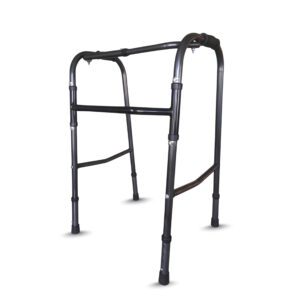
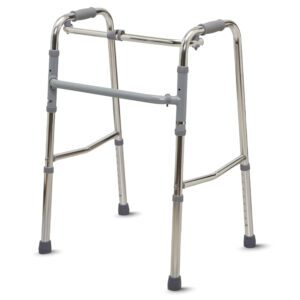
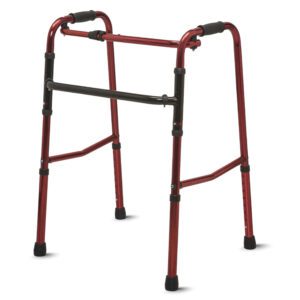
Standard folding walker (no wheels) The most stable option. All four legs stay planted while the user shifts weight onto the frame, so the walker has to be lifted slightly with each step. Best for people with reasonable upper-body strength who need maximum stability. Our lightest steel models start at ₹1,100.
Reciprocal walker A middle ground. The frame flexes so each side can move forward in a zig-zag motion without being lifted off the floor. This suits users who find lifting a walker tiring but aren’t ready for wheels.
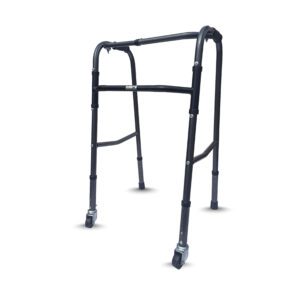
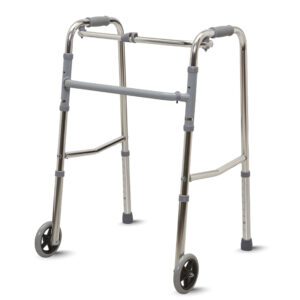
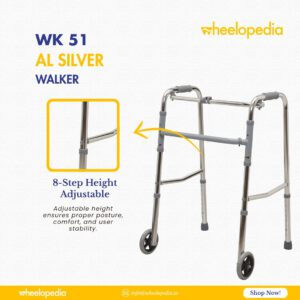
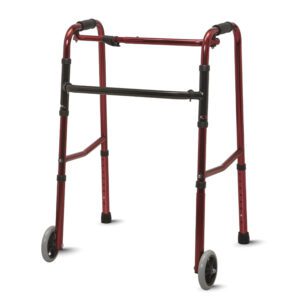
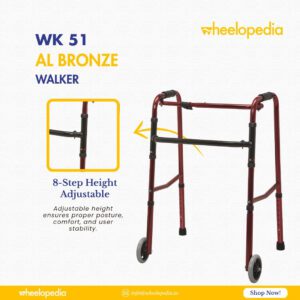
Walker with wheels (two-wheel) Two wheels at the front legs and rubber tips at the back. The user pushes rather than lifts, which conserves energy over longer distances — while the rear tips still grip when weight is applied. A good fit for elderly users with limited arm strength.
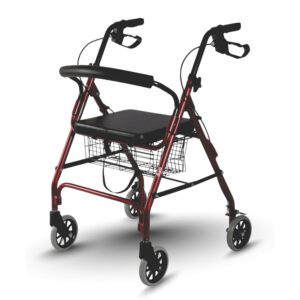
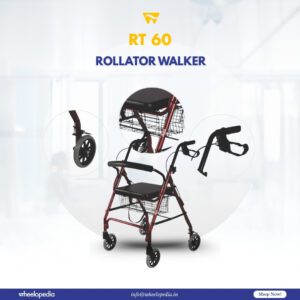
Four-wheel rollator Four castor wheels, hand brakes, and storage space. Built for users who can walk reasonably well but need something to lean on and steer. Best suited to smooth indoor floors and even outdoor paths.
How to choose a walker for elderly people
- User height. With arms relaxed at the sides, the handgrips should sit level with the wrist crease. All Wheelopedia walkers are height adjustable, but check that the user’s height falls inside the model’s range.
- Weight capacity. Match the walker’s rated capacity to the user’s weight with margin to spare. Mild steel frames generally carry more; aluminium trades some capacity for lower weight.
- Walker weight. This is the factor most buyers overlook. If the user has to lift the walker with every step, or a family member is carrying it in and out of a car, a lighter aluminium frame makes a daily difference.
- Where it will be used. Tiled indoor floors, uneven Indian pavements, and hospital corridors are three different problems. Wheels help on smooth surfaces; fixed legs are safer on uneven ground.
- Folding and storage. A foldable walker for adults collapses flat so it can be tucked beside a bed, slid into a car boot, or carried to a clinic appointment.
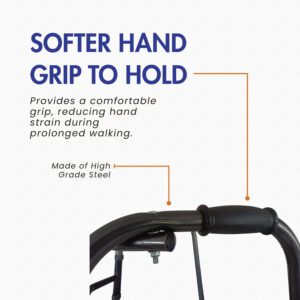
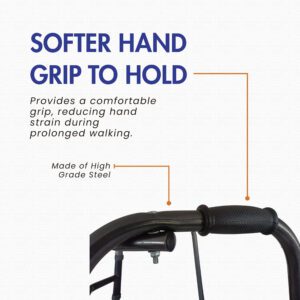
- Grip and tips. Comfortable, non-slip handgrips and anti-skid rubber tips are what actually prevent falls. Rubber tips wear out — check them every few months and replace when the tread flattens.
Mild steel or aluminium?
| Mild steel (MS) | Aluminium | |
| Frame weight | Heavier | Noticeably lighter |
| Load capacity | Typically higher | Slightly lower |
| Corrosion | Powder coated; needs care in humid or bathroom use | Naturally rust resistant |
| Price | More affordable entry point | Higher |
| Best for | Users needing maximum support at a lower budget | Users who lift or carry the walker often, and daily travel |
If the walker will mostly stay in one room and cost matters, mild steel is sensible. If it travels with the user or has to be lifted with every step, aluminium is worth the difference.
Why buy your walker from Wheelopedia
- Free delivery across India on every walker, with no minimum order
- Easy EMI and cash on delivery so a mobility aid isn’t an upfront burden
- Free home demo — try the walker in the space where it will actually be used
- 19 store locations nationwide for in-person guidance and after-sales support
- Rated 4.8 by customers on Google
- Real people on the phone — call +91 70448 57052 and speak to someone who knows the products
Also worth looking at
- Walking sticks and canes — for users who need light support on one side only
- Manual wheelchairs — when walking distance is very limited
- Commode and toilet chairs — for bathroom safety alongside a walker
- All walking aids
Frequently asked questions
What is the best walker for adults? There’s no single best walker — the right one depends on the user’s height, weight, how much support they need, and where the walker will be used. As a rule of thumb: choose a fixed-leg folding walker for maximum stability, a walker with wheels if lifting is tiring, and a four-wheel rollator if the user walks reasonably well but needs something to lean on. If you’re unsure, book a free home demo or call us and we’ll help you narrow it down.
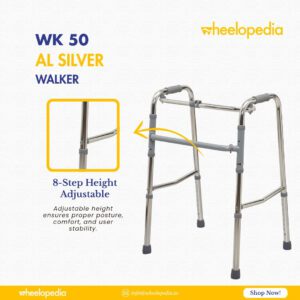
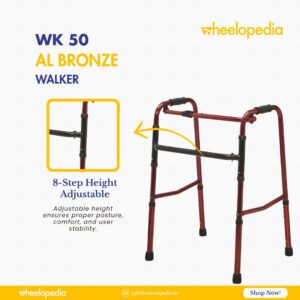
Why choose a folding walker? A folding walker gives the same support as a rigid frame but collapses flat when it isn’t in use. That makes it easy to keep beside a bed, carry in a car, or take to hospital and rehabilitation appointments. Most folding walkers also offer adjustable height, cushioned handgrips, and anti-slip tips.
What’s the difference between a walker with wheels and one without? A walker with wheels has castors on the front legs, so the user pushes it forward instead of lifting it — less effort over distance, which helps elderly users with limited arm strength. A walker without wheels stays completely planted and offers more stability, but has to be lifted with each step. Wheelopedia also stocks reciprocal walkers, which move forward in an alternating motion without needing to be lifted.
Which walker is best for old people who have had surgery? During early recovery, most people are advised to use a fixed-leg or reciprocal walker, since maximum stability matters more than walking speed. As strength returns, many switch to a walker with wheels or a rollator. Follow your physiotherapist’s or surgeon’s advice on which to use and when.
What height should a walker be set to? Stand upright inside the walker with your shoulders relaxed and arms hanging naturally. The top of the handgrip should line up with the crease of your wrist. At that height, your elbows bend about 15–20 degrees when you hold the grips — that’s the position that lets you take weight safely.
How much do walkers for adults cost in India? At Wheelopedia, lightweight steel folding walkers start at ₹1,100, aluminium height-adjustable walkers run ₹2,550–₹2,850, and four-wheel rollators with safety brakes are ₹7,800. All prices include free delivery, and EMI is available.
Can I try a walker before buying? Yes. We offer a free home demo across serviceable pincodes, and you can visit any of our 19 store locations. Enter your pincode on the product page or call +91 70448 57052 to arrange it.
Do you deliver walkers across India? Yes — free delivery PAN India, with cash on delivery available in most locations.